Image credit: The organising committee
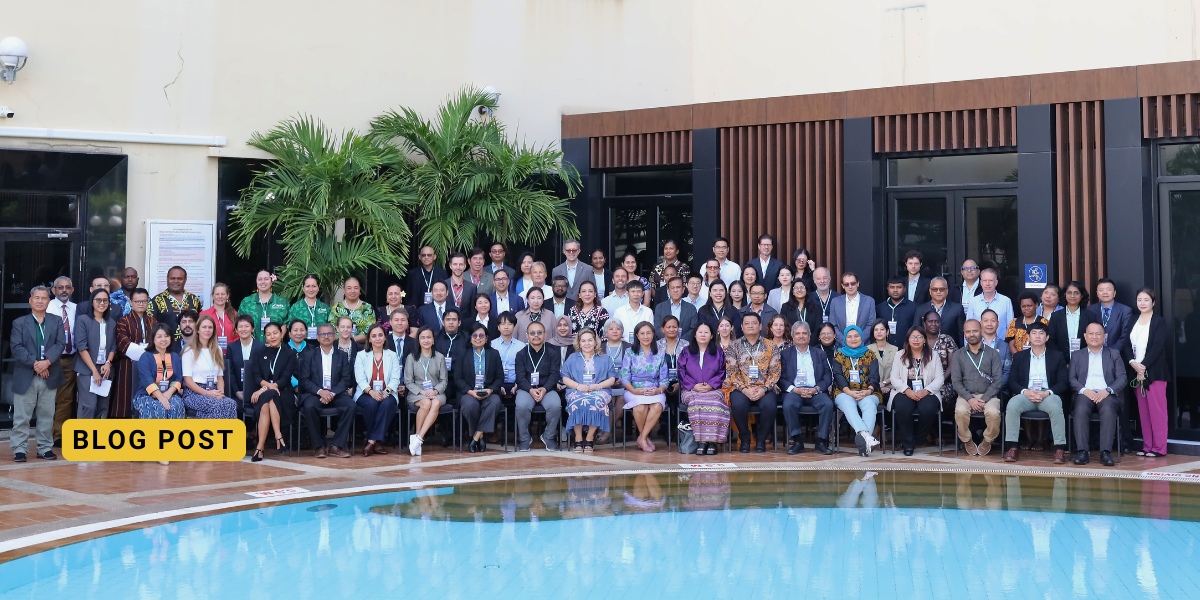
For three days, governments, UN agencies, regional bodies, and civil society organisations convened in Bangkok for the Asia and the Pacific Workshop on Accelerating the Implementation of the Kunming-Montreal Global Biodiversity Framework (KM-GBF) through an Integrated and Synergistic Approach from 7 to 9 October 2025. The regional workshop was co-organised by the United Nations Environment Programme (UNEP), United Nations Development Programme (UNDP), Food and Agriculture Organisation (FAO), the Convention on Biological Diversity (CBD) Secretariat, and the Secretariat of the Pacific Regional Environment Programme (SPREP), with support from the China-UNEP Trust Fund and the Global Environment Facility (GEF).
The workshop aimed to support countries in translating the KM-GBF into accelerated national action and to build coherence across multiple multilateral environmental agreements (MEAs). Women4Biodiversity participated as a stakeholder organisation, sharing perspectives and lessons from its work at the intersection of gender equality and biodiversity policy implementation. This meeting was followed by the Regional Dialogue for East and South Asia on Biodiversity Monitoring and Reporting in Bangkok from the 9th to the 10th of October 2025, again organised by the CBD Secretariat.
The Asia-Pacific workshop was designed to reflect an intention to work with Parties to the CBD to bridge policy silos and create pathways for synergies among biodiversity-related MEAs. Plenary and breakout sessions were organised around three thematic nexuses: Biodiversity and Agri-Food Systems, Biodiversity and Health, and Biodiversity and Climate, as well as a dedicated segment on Synergies Across MEAs. This structure echoed the realities many countries face: overlapping mandates, fragmented data systems, and parallel reporting calendars. While updates from the CBD Secretariat and partners indicated progress, gaps remain in countries’ submissions of national targets and in advancing updates to the National Biodiversity Strategy and Action Plan (NBSAP). The alignment with the Monitoring Framework for the Kunming-Montreal Global Biodiversity Framework is inconsistent, and many national indicators remain unoperationalised. Countries are preparing for the Global Review at COP-17 and the submission of the 7th National Reports, but several continue to face difficulties in adapting global indicators to national contexts.

UNEP presented its unpublished rapid assessment of regional progress, in which it highlighted persistent challenges:
- Limited domestic biodiversity financing,
- Dependence on donor-funded projects,
- Technical gaps in monitoring, evaluation and reporting (MER), and
- Difficulties in harmonising indicators across biodiversity, climate, and health portfolios.
- Stakeholder participation, especially that of women, youth, and Indigenous Peoples and Local Communities (IPs and LCs), was repeatedly cited as an area requiring significant strengthening, both in NBSAP revision and in implementation.
Peer exchanges among countries underscored that inter-ministerial committees, task forces, and whole-of-government approaches generate momentum, but these mechanisms require clear reporting lines, defined indicator sets, and budgets linked to national finance systems rather than project cycles. Countries that explicitly aligned their NBSAPs with National Development Plans and Nationally Determined Contributions (NDCs) demonstrated more consistent uptake and ownership, suggesting that biodiversity mainstreaming is most effective when embedded within core national planning frameworks.
Examples from the region showcased diverse approaches: community-based monitoring and citizen science initiatives have produced rich datasets for terrestrial species, though marine and coastal ecosystems remain underrepresented. Other models included university-ministry partnerships and inter-ministerial monitoring reviews. Across cases, countries stressed the importance of standardisation, moderation of data collection efforts, and the financing of data stewardship as a long-term function rather than an ad-hoc activity.

During the stakeholder panel, Women4Biodiversity emphasised the central role of the Gender Plan of Action (GPA) 2023–2030, adopted alongside the KM-GBF at CBD COP-15. Building on earlier GPAs (Bonn, 2008; Pyeongchang, 2014), the current plan sets a more ambitious vision, embedding a gender-responsive, rights-based, and intersectional approach into every stage of KM-GBF implementation. The GPA outlines clear outcomes, deliverables, and responsible actors, transforming gender equality from a cross-cutting aspiration into an operational priority. It also directly links to Target 23, the KM-GBF’s dedicated gender target, which calls for national frameworks to ensure women’s equal rights and access to land and natural resources.
Women4Biodiversity collaborated with UNEP-WCMC and government partners to co-develop a methodology for the GPA component indicator, enabling countries to translate policy commitments into measurable progress. Beyond policy, Women4Biodiversity also highlighted its efforts to bridge practice and policy. Women4Biodiversity supported six women-led restoration initiatives, connecting these leaders with national Gender Focal Points (GFPs) and NBSAP teams. This model of linking local implementation with national policy dialogue has evolved into Restore Her Rights, an initiative that integrates women’s leadership and gender-responsive indicators directly into NBSAP implementation processes.

Women4Biodiversity also presented a rapid scan of 33 Asia-Pacific countries that were invited to the workshop which revealed that:
- Only four countries have both a gender target and an appointed GFP in their NBSAP processes.
- Approximately 14 countries have one or the other.
- 19 countries have neither.
This data underscores that while gender is increasingly acknowledged in biodiversity policy, only around 10 percent of countries have institutionalised it from planning to implementation and monitoring. The solution, as underscored in the workshop, lies in appointing and empowering GFPs, adopting a national gender target aligned with Target 23, and resourcing a monitoring plan that uses sex-disaggregated data and GPA-aligned indicators.

In the regional dialogue that followed, Women4Biodiversity was encouraged to share more about the indicator methodology for tracking the implementation of the Gender Plan of Action and Target 23 of the KM-GBF, and to demonstrate practical approaches to link gender-responsive action with national reporting processes. Discussions underscored that simple, usable indicators grounded in existing data and strengthened through capacity building can be more transformative than overly complex systems.
As countries in East and South Asia prepare their seventh national reports, the dialogue made clear that inclusive monitoring, strengthened regional cooperation with stakeholders, and sustained support for capacity development will be essential to translating global commitments into equitable, on-the-ground biodiversity outcomes.
From Women4Biodiversity’s perspective, these dialogues were especially significant in highlighting the need to move beyond purely ecological metrics and ensure that gender equality and social inclusion are visible within national monitoring and reporting frameworks.