
On World Environment Day 2026 – Inspired by Nature. For Climate. For Our Future
When the tide pulls back along stretches of the Indian coast in Odisha, groups of women wade into the grey mud to push mangrove seedlings into the silt. The work is slow and unglamorous, yet one of the most effective forms of environmental action available to a coastal community. Many of them know exactly what an unprotected shore can do. They remember the cyclones and storm surges that once flooded their villages, drowned their fields, and pulled their livelihoods out to sea. Having lived through that, they now spend their mornings rebuilding the very forests that stand between their homes and the water, stitching a green barrier back into the coastline for the families who will come after them.

Photo courtesy: Women from Sana Jhadling village carry mangrove saplings to the planting site as part of a community-led conservation effort. These saplings will be planted along the riverbank to protect against soil erosion and support local biodiversity / Aishwarya Mohanty
A restored mangrove belt protects more than the climate. It blunts storm surges and slows coastal erosion; it rebuilds a nursery for the fish, crabs and shellfish that coastal households eat and sell, and the web of life around them. For the women who gather that catch and read the tides, the mangrove is a larder and a livelihood, not an abstraction — which is why this is best understood as ecosystem-based adaptation: a living defence that protects people while it provisions them. A healthy mangrove also stores carbon, more per hectare than most tropical forests on land, which is indeed valuable, but for the household on the shoreline, it is the last reason to plant, not the first.
In a single stretch of mud, the climate and biodiversity crises are being addressed at once. The stakes are considerable: mangroves store three to five times more carbon than upland tropical forests, yet an estimated 35% of the world’s mangroves were lost between 1980 and 2000; losses continue, and restoration is uneven.
There is a paradox worth sitting with on World Environment Day. The people most exposed to a destabilized climate and a fraying ecological integrity/ecosystems are often the same people who hold the knowledge to respond to and repair both. That tension runs straight through nature-based solutions, or NbS, which the CBD defines as ‘Actions to protect, conserve, restore, sustainably use and manage natural or modified terrestrial, freshwater, coastal and marine ecosystems, which address societal, economic and environmental challenges effectively and adaptively, while simultaneously providing human well-being and biodiversity benefits’.
NbS is, in effect, the point where the climate and biodiversity agendas stop being separate conversations. The 2026 theme of the World Environment Day, « Inspired by Nature. For Climate. For Our Future, » prompts a question that is seldom asked out loud: inspired by whose relationship with nature?
The argument is simple. Women are both the most exposed to environmental breakdown and among the most equipped to lead the response to it, across climate and biodiversity alike. NbS will deliver on its promise only if it is built with that fact at the center rather than as an afterthought.
The most exposed, the most equipped
The first half of that claim is well documented and not at all mysterious. Women’s heightened climate vulnerability follows from social inequality, not from anything intrinsic. When disasters strike, women tend to face disadvantages in mobility, access to information, decision-making power, and control over resources, and they are often less able to reach relief and recovery support afterwards. The pattern shows up in ordinary detail as much as in catastrophe. During the prolonged drought that gripped Kenya’s Turkana County between 2020 and 2022, women walked further for scarcer water and, when food ran short, ate less than the men in their households.
Much of this traces back to who does the daily work of provisioning. Across many rural economies, women are the ones who collect water and fuel, grow much of the food, and gather non-timber products from forests. When climate stress lengthens those journeys, it lengthens women’s working day, raises their exposure to violence on isolated routes, and pulls girls out of school to help. A 2025 systematic review of the literature on climate change and women’s health found that gender, working alongside other social factors, consistently shapes people’s capacity to adapt, with women in agriculture-dependent settings particularly constrained by norms and unequal control over assets. None of this is new to climate science; the IPCC’s Sixth Assessment recognizes these differentiated vulnerabilities as a feature of the distribution of climate risk.
Here is the part that gets less attention. The same proximity to forests, fields, and water that exposes women also makes many of them keepers of fine-grained ecological knowledge, and there is hard evidence that this knowledge matters for outcomes, not just for fairness. Studies of community forest groups across parts of India and Nepal tested whether the gender composition of a management group affected conservation. Groups with more women showed better forest protection and compliance with rules, and all-women executive committees in Nepal achieved stronger regeneration and canopy growth than other groups, even though they were allotted smaller, more degraded forests to manage. Stronger forest regeneration is a carbon gain and a habitat gain in the same stroke, which is the point: the climate and biodiversity benefits should not be a trade-off; they should arrive together. The finding has held up elsewhere, too: a cross-country analysis linked women’s participation to better forest governance.
But we should be careful not to overstate this. The strongest evidence comes from forest and fishery commons, not from every kind of NbS, and the relationship depends on women having real influence rather than nominal seats. But the direction is clear enough to retire a tired framing. Women’s participation in managing and restoring ecosystems is not just a gesture of inclusion; it is a predictor of success.

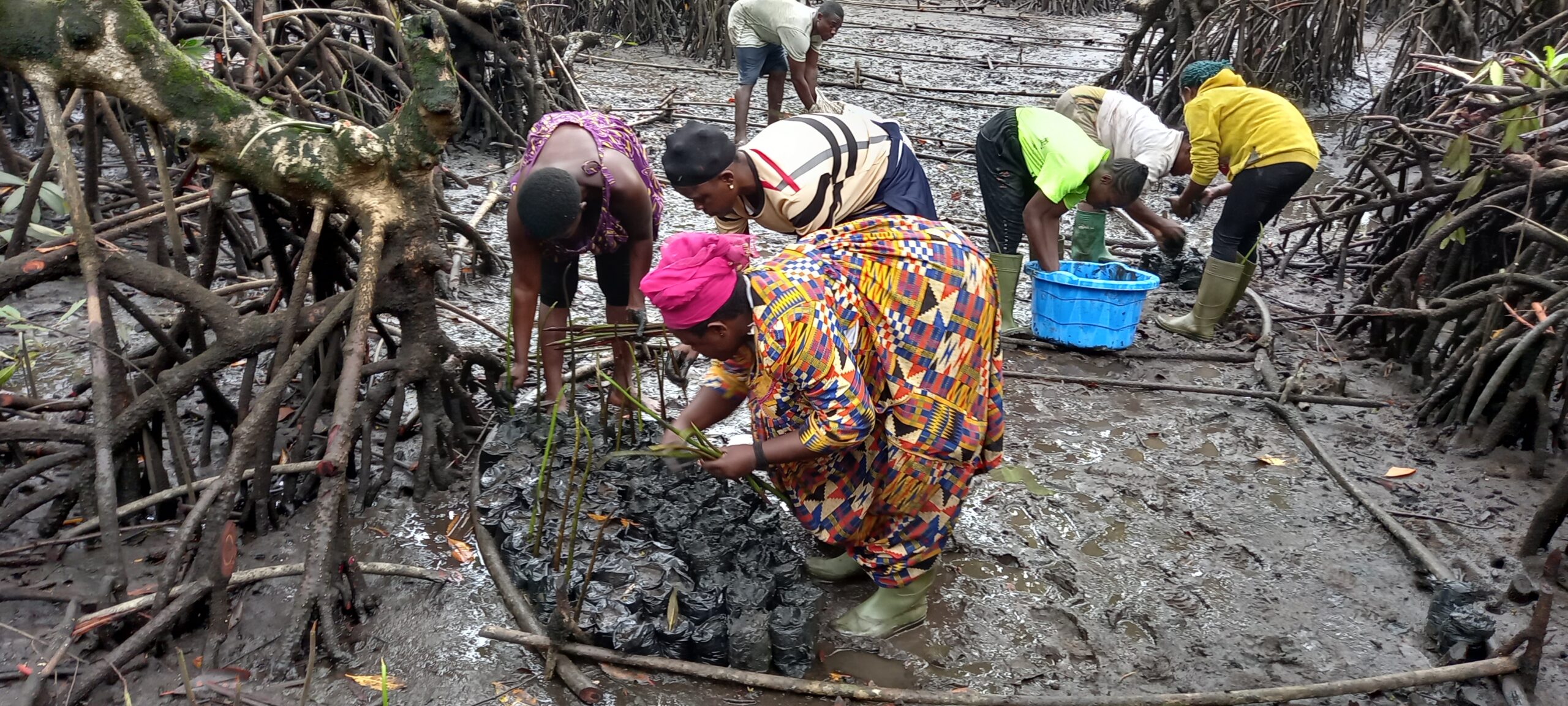
Photo courtesy: Women from Lodji, Cameroon and their mangrove nursery/ Women4Biodiversity
A double-edged solution
If women are both vulnerable and capable, NbS is the meeting point of those two truths, which is exactly why it also deserves scrutiny rather than only applause. The appeal of NbS is that a single intervention can do several jobs at once, cutting emissions, reducing disaster risk, supporting livelihoods, and recovering biodiversity. What that summary hides is that the social outcomes are not built in. They depend on design.
NbS holds real promise for women, but whether that promise is realized depends on design. When women are not placed at the center from the outset, two risks recur. The first is that a project entrenches the very inequality it sets out to ease: without deliberate design, it can add unpaid labor to women’s already long days while routing the benefits (carbon payments, training, title to restored land) toward men, particularly where women hold no secure rights to land or resources. Nature-based solutions can be a vehicle for genuine empowerment, but it can just as easily reproduce the power relations already in place; the outcome is not guaranteed by good intentions alone.
The second risk is more direct. NbS work often happens in isolated places such as wetlands, forests and riverbanks, and without deliberate attention to safety, sending women into those settings can raise their exposure to gender-based violence. This is not an argument against women’s participation, but rather that safety has to be built in from the start. Both risks are compounded by an evidence base thinner than the enthusiasm: the International Institute for Sustainable Development notes a real gap in documented NbS projects that actually deliver gender equality and social inclusion outcomes, and practitioners report that equity is too often treated as a reporting requirement rather than a design parameter. The honest position, then, is not that NbS automatically empowers women, nor that it inevitably burdens them. It is that NbS can do either, and which one occurs is decided early, in design choices that most projects barely plan for.
So far, the biodiversity half of that story has stayed mostly in the background of the climate one. It is worth examining on its own terms, because the gendered pattern there is, if anything, sharper. In many farming and forest communities, women are the ones who select, save, and exchange seed, who maintain the diversity of crops and wild foods that cushion a household against a failed harvest, and who carry working knowledge of which species do what. Yet the evidence on how biodiversity loss affects women, and on what their knowledge contributes, is strikingly thin. A review on the same line concluded that there is very little peer-reviewed evidence on gender and biodiversity, an under-researched area in which women face distinct, intersecting vulnerabilities while also acting as agents of change. There is a real value in integrating gender into conservation and restoration, and the Parties to the Convention on Biological Diversity for the same reason, have prioritized gender-responsive delivery of the Kunming-Montreal Global Biodiversity Framework through its Gender Plan of Action (2023 – 2030).
Evidence suggests that defending an ecosystem is a huge task that falls unevenly, and the people most often doing it on the frontline are precisely those whose knowledge conservation science says it needs. An honest account of women’s role in nature-based solutions must hold both facts at once: their age-old knowledge is an asset, but exercising it can carry real costs
Designing for resilience and equity: where this leaves us
The honest tally is uneven, but it leans hopeful. Some of the evidence, drawn from forest and fishery commons, is genuinely encouraging: where women hold real influence over how a resource is managed, protection improves, and ecosystems recover, with carbon and habitat gains occurring in tandem. The picture of biodiversity more broadly remains thin, not because the relationship appears weak, but because research is only beginning to catch up, and documentation of gender outcomes across NbS is improving from a low base. The gaps are real. So is the direction of travel, and it points one way. That is enough to act on, and acting is the optimistic choice. Designing women in from the start is not a concession or a quota. It is how a project gains the knowledge of the people who already read the tides, the soils, and the seasons, and how its benefits reach the households that will carry the work long after the funding ends.
Momentum is gathering here, and it is encouraging to watch it build. The IUCN runs gender-responsive nature-based solutions programs that place women’s leadership and their safety at the center of ecosystem restoration. The FAO has made gender equality a pillar of its work across farming, forestry, and fisheries, and has named 2026 the International Year of the Woman Farmer. And in India, consortia such as the Consortium for Agroecological Transformations (CAT) and Women4Biodiversity support and document the work of women leading restoration efforts in their communities. are building some of their landscape-level agricultural NbS interventions around women farmers, pursuing biodiversity and climate gains in a single stroke. There are many more examples globally of the design questions being increasingly asked within the institutions that fund and run the work.
The fair and effective options are the same. That alignment is rare and useful, and World Environment Day is a good moment to act on it.
Which returns us to the mudflats. By afternoon, the tide will be back, and the seedlings pushed into the silt this morning will be doing the quiet work they were planted for: holding the shoreline, drawing down carbon, opening a nursery for the fish and crabs that feed the village. Give the women doing this work secure protection from climate change, a real say in the land’s future, and a share in what it yields, and that single stretch of mud becomes a template. Multiply it across the world’s coastlines, forests, and floodplains, and the repair compounds.
This year’s call is to be inspired by nature, for the climate, for our future. The most exact way to honor it is to be inspired by the people who have never stopped listening to nature, and to build the next decade of climate and biodiversity work so it finally counts them in. They are not waiting to be asked. As the tide turns, they are already in it, hands in the silt, building the shoreline on which the future will stand.
References
Nature-based Solutions: Acknowledges that the concept of nature-based solutions is cognizant of and in harmony with the concept of ecosystem-based approaches identified under the Convention on Biological Diversity and other management and conservation approaches carried out under existing national policy and legislative frameworks and established under relevant multilateral environmental agreements (UNEP/EA.5/Res.5)
- https://www.cbd.int/doc/c/c3ab/388d/950ddc02586468a814120acf/wg2020-05-04-en.pdf
- IUCN (2026). Global Standard for Nature-based Solutions: Second Edition. Gland: IUCN.
- https://wrd.unwomen.org/explore/insights/pastoral-communities-kenya-women-bear-brunt-drought
- Salcedo-La Viña, C., Trivedi, A. and Grace, K., 2023. Enabling rural women as key actors in naturebased solutions. World Resources Institute. https://doi. org/10.46830/wriwp, 21.
- https://www.unwomen.org/en/articles/explainer/how-gender-inequality-and-climate-change-are-interconnected
- Anjum, G. and Aziz, M., 2025. Climate change and gendered vulnerability: A systematic review of women’s health. Women’s Health, 21, p.17455057251323645.,
- https://www.ipcc.ch/report/ar6/wg2/
- Agarwal, B., 2009. Gender and forest conservation: The impact of women’s participation in community forest governance. Ecological economics, 68(11), pp.2785-2799.
- Coleman, E.A. and Mwangi, E., 2013. Women’s participation in forest management: A cross-country analysis. Global Environmental Change, 23(1), pp.193-205.
- https://aidmi.org/blog/nature-based-solutions-must-protect-women-not-put-them-at-risk/
- Caswell, C. and Jang, N., 2024. Mainstreaming gender equality and social inclusion in nature-based solutions for climate change adaptation.
- Tallent, T. and Zabala, A., 2024. Social equity and pluralism in Nature-based Solutions: Practitioners’ perspectives on implementation. Environmental Science & Policy, 151, p.103624.
- Booker¹, F., Allison, H., Nash, F. and Green⁴, A., 2022. Women, girls and biodiversity loss: an evidence and policy review.
- https://www.cbd.int/gbf/targets/23
Disclaimer: The views expressed in this blog are those of the author(s) and do not necessarily reflect the official position or opinions of Women4Biodiversity

N. Manika
Conservation ecologist with 14 years of demonstrated expertise in biodiversity conservation, ecosystem restoration, and climate change mitigation across diverse institutional landscapes. Her work has centered on the ecologically critical Terai and eastern Himalayan regions, where she has led research and implementation initiatives addressing complex conservation challenges at the science-policy-community nexus.

Mrinalini Rai
Mrinalini is an advocate for women's rights and environmental justice. She specializes in policy, advocacy, and research that addresses the intersectionality of human rights, gender equality, and environmental governance.