
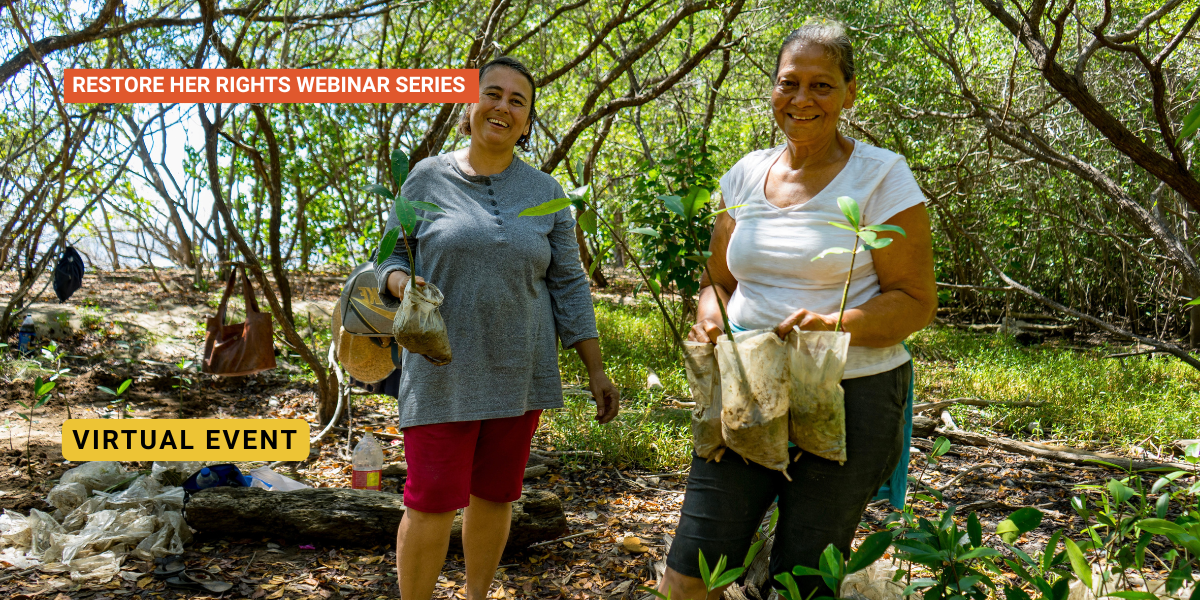
Image credit and copyright: CoopeSoliDar R.L. 2024
WHAT
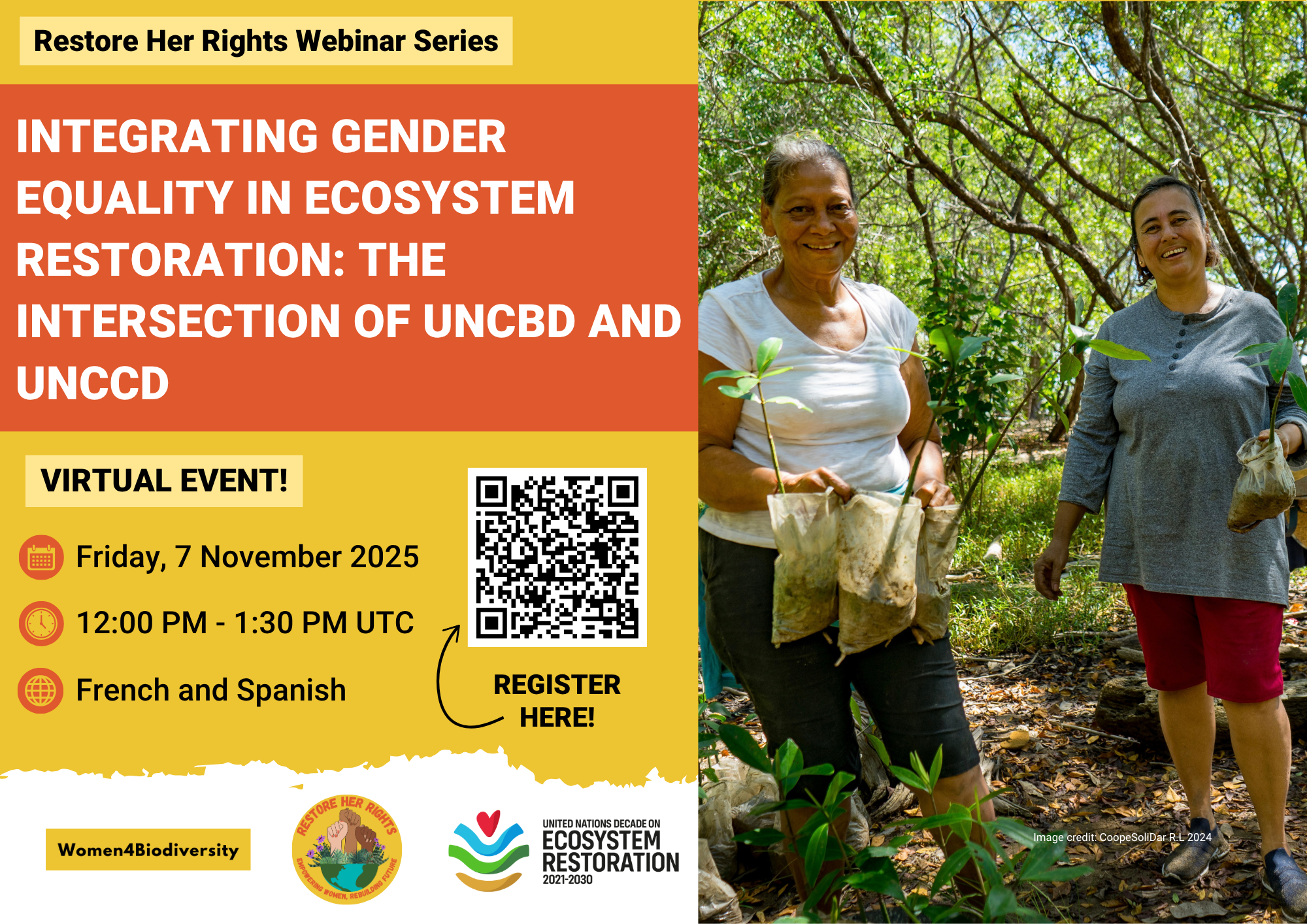
This is the sixth webinar in the Restore Her Rights Initiative Webinar Series will conduct a crucial policy analysis, examining how gender equality and ecosystem restoration intersect within the two major global frameworks: the UN Convention on Biological Diversity (UNCBD) and the UN Convention to Combat Desertification (UNCCD). The session will spotlight policy commitments, challenges, and opportunities to strengthen gender-responsive restoration efforts across both land and biodiversity agendas, offering practical insights for meaningful integration into global and local initiatives.
WHEN
Friday, 07 November 2025, from 12.00 pm to 1.30 pm UTC. Please check your timezone here.
WHERE
Online event. Register for the event.
WHO
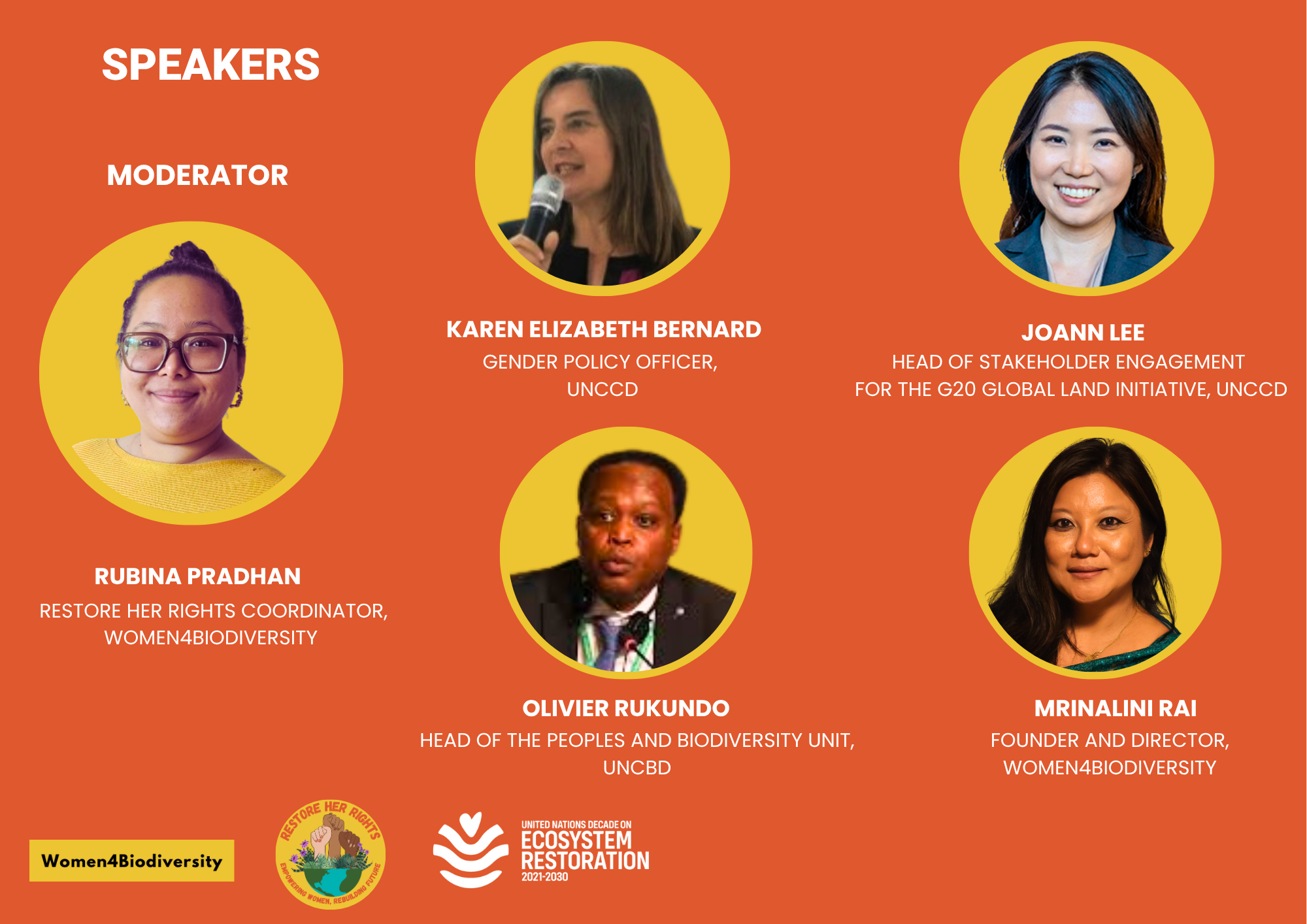
- Karen Elizabeth Bernard, Gender Policy Officer, United Nations Convention to Combat Desertification (UNCCD)
- Joann Lee, Head of Stakeholder Engagement for the G20 Land Initiative, United Nations Convention to Combat Desertification (UNCCD)
- Olivier Rukundo, Head of the Peoples and Biodiversity Unit, Convention of Biological Diversity (UNCBD)
- Mrinalini Rai, Founder and Director, Women4Biodiversity
- Rubina Pradhan, Restore Her Rights Coordinator, Women4Biodiversity – Moderator
WHY
- To gain unique, high-level insights from UNCBD and UNCCD’s policy experts on how gender equality is being integrated into biodiversity goals and land degradation efforts across both major Rio Conventions.
- To learn practical strategies for designing and implementing restoration projects that align directly with the UNCBD’s and UNCCD’s emphasis on gender equality.
- To explore the application of the key guiding documents, which are the UNCBD’s Gender Plan of Action (GPA) and UNCCD’s Gender Action Plan (GAP).
This webinar is part of a larger series, the “Restore Her Rights Initiative Webinar Series,” which runs April to November. The series focuses on advancing gender equality and women’s roles in ecosystem restoration, addressing barriers, and promoting gender-responsive policies.
Espanol
QUÉ
Este es el sexto seminario web de la serie de seminarios web de la iniciativa Restore Her Rights, en el que se llevará a cabo un análisis político crucial, examinando cómo la igualdad de género y la restauración de los ecosistemas se entrecruzan en los dos principales marcos globales: el Convenio de las Naciones Unidas sobre la Diversidad Biológica (UNCBD) y la Convención de las Naciones Unidas de Lucha contra la Desertificación (UNCCD). La sesión se centrará en los compromisos políticos, los retos y las oportunidades para reforzar los esfuerzos de restauración con perspectiva de género en las agendas sobre la tierra y la biodiversidad, y ofrecerá ideas prácticas para una integración significativa en las iniciativas globales y locales.
CUÁNDO
Viernes, 7 de noviembre de 2025, de 12:00 a 13:30 UTC. Por favor, compruebe su zona horaria aquí.
DÓNDE
Evento en línea. Inscríbase en el evento.
QUIÉN
- Karen Elizabeth Bernard, responsable de políticas de género, Convención de las Naciones Unidas de Lucha contra la Desertificación (UNCCD)
- Joann Lee, Jefe de Participación de las Partes Interesadas para la Iniciativa sobre la Tierra del G20, Convención de las Naciones Unidas de Lucha contra la Desertificación (UNCCD)
- Olivier Rukundo, jefe de la Unidad de Pueblos y Biodiversidad, Convenio sobre la Diversidad Biológica (CDB)
- Mrinalini Rai, fundadora y directora, Women4Biodiversity
- Rubina Pradhan, coordinadora de Restore Her Rights, Women4Biodiversity – Moderadora.
POR QUÉ
- Obtener información única y de alto nivel de los expertos en políticas del CDB y la CNULD sobre cómo se está integrando la igualdad de género en los objetivos de biodiversidad y los esfuerzos de lucha contra la degradación de la tierra en las dos principales convenciones de Río.
- Aprender estrategias prácticas para diseñar y ejecutar proyectos de restauración que se ajusten directamente al énfasis del CDB y la CNULD en la igualdad de género.
- Explorar la aplicación de los documentos rectores clave, que son el Plan de Acción de Género (GPA) del CDB y el Plan de Acción de Género (GAP) de la CNULD.
Este seminario web forma parte de una serie más amplia, «Restore Her Rights Initiative Webinar Series», que se celebra de abril a octubre. La serie se centra en promover la igualdad de género y el papel de las mujeres en la restauración de los ecosistemas, abordar las barreras y promover políticas que tengan en cuenta las cuestiones de género.
Francais
QUOI
Il s’agit du sixième webinaire de la série de webinaires de l’initiative Restore Her Rights. Il proposera une analyse politique cruciale, examinant comment l’égalité des sexes et la restauration des écosystèmes s’articulent au sein des deux principaux cadres mondiaux : la Convention des Nations unies sur la diversité biologique (UNCBD) et la Convention des Nations unies sur la lutte contre la désertification (UNCCD). La session mettra en lumière les engagements politiques, les défis et les opportunités visant à renforcer les efforts de restauration sensibles au genre dans les programmes relatifs aux terres et à la biodiversité, et offrira des perspectives pratiques pour une intégration significative dans les initiatives mondiales et locales.
QUAND
Vendredi, 7 novembre 2025, de 12 h à 13 h 30 UTC. Veuillez vérifier votre fuseau horaire ici.
Où
Événement en ligne. S’inscrire à l’événement.
QUI
- Karen Elizabeth Bernard, responsable des politiques de genre, Convention des Nations unies sur la lutte contre la désertification (UNCCD)
- Joann Lee, Responsable de l’engagement des parties prenantes pour l’Initiative foncière du G20, Convention des Nations Unies sur la lutte contre la désertification (UNCCD)
- Olivier Rukundo, chef de l’unité « Peuples et biodiversité » de la Convention sur la diversité biologique (CDB)
- Mrinalini Rai, fondatrice et directrice, Women4Biodiversity
- Rubina Pradhan, coordinatrice de Restore Her Rights, Women4Biodiversity – Modératrice
POURQUOI
- Obtenir des informations uniques et de haut niveau de la part des experts politiques de la CDB et de la CNULD sur la manière dont l’égalité des sexes est intégrée dans les objectifs de biodiversité et les efforts de lutte contre la dégradation des terres dans les deux grandes conventions de Rio.
- Apprendre des stratégies pratiques pour concevoir et mettre en œuvre des projets de restauration qui s’alignent directement sur l’accent mis par la CDB et la CNULD sur l’égalité des sexes.
- Explorer l’application des principaux documents d’orientation, à savoir le Plan d’action pour l’égalité des sexes (GPA) de la CDB et le Plan d’action pour l’égalité des sexes (GAP) de la CNULCD.
Ce webinaire fait partie d’une série plus large, « Restore Her Rights Initiative Webinar Series », qui se déroule d’avril à octobre. Cette série vise à promouvoir l’égalité des sexes et le rôle des femmes dans la restauration des écosystèmes, à lever les obstacles et à encourager les politiques sensibles au genre.
Event Summary
Two of the major Rio Conventions, United Nations Convention on Biological Diversity (UNCBD) and United Nations Convention to Combat Desertification (UNCCD), are committed to advancing gender equality and women’s empowerment, as well as the inclusion of Indigenous Peoples’ and Local Communities (IPs and LCs) and marginalised groups in the restoration and conservation of ecosystems. Notably, the Kunming-Montreal Global Biodiversity Framework (KM-GBF) , a framework within the UNCBD, along with the UNCCD are aligned through shared goals related to ecosystem restoration, land management, and addressing the interlinked global crises of biodiversity loss, climate change, and land degradation. Both frameworks recognise that achieving their respective objectives requires integrated and synergistic action.
This webinar examined how gender equality and ecosystem restoration are addressed within the United Nations Convention to Combat Desertification (UNCCD) and the United Nations Convention on Biological Diversity (UNCBD). However, due to technical difficulties, Olivier Rukundo from the Secretariat of the UNCBD was unable to join the webinar. So, the online event was redirected to highlight the excellent work being carried out by the UNCCD.
The discussion highlighted policy commitments and the implementation of frameworks, such as the UNCCD’s Gender Action Plan (GAP), which focuses on four priority areas, including women’s equal participation, access to knowledge and technologies, economic empowerment, and land rights, in tandem with UNCCD’s Gender Roadmap. The session also spotlighted challenges, opportunities to strengthen gender-responsive restoration and real-world restoration success stories.
In light of the webinar, the UNCCD has demonstrated a strong commitment towards promoting gender equality and empowering women. This is highlighted through their adoption of the Gender Action Plan (GAP), which has been in implementation since 2014. The GAP’s guiding principles include respecting human rights, gender equality, and intersectionality. Priority action areas of UNCCD’s GAP include:
- Strengthening women’s and girls’ access to land, tenure, and resources.
- Ensuring women’s meaningful participation and leadership in decision-making on land degradation, restoration, and drought management.
- Capacity building and gender disaggregated data collection.
- Mobilising financing and partnerships that are gender responsive.

At the UNCCD’s 15th session of the Conference of the Parties (COP15) held in Abidjan, Côte d’Ivoire in 2022, a Gender Road Map to accelerate implementation of GAP was adopted to ensure that the UNCCD picks up the pace towards transformative change. The UNCCD has also established a Gender Caucus, composed of country champions, select UN agencies and CSO partners, to provide expert guidance on how to focus strategies on gender issues in drought, land degradation and desertification. The Gender Caucus convenes at each Committee for the Review of the Implementation of the Convention (CRIC) and UNCCD COP.

Gender Mainstreaming in Land Degradation
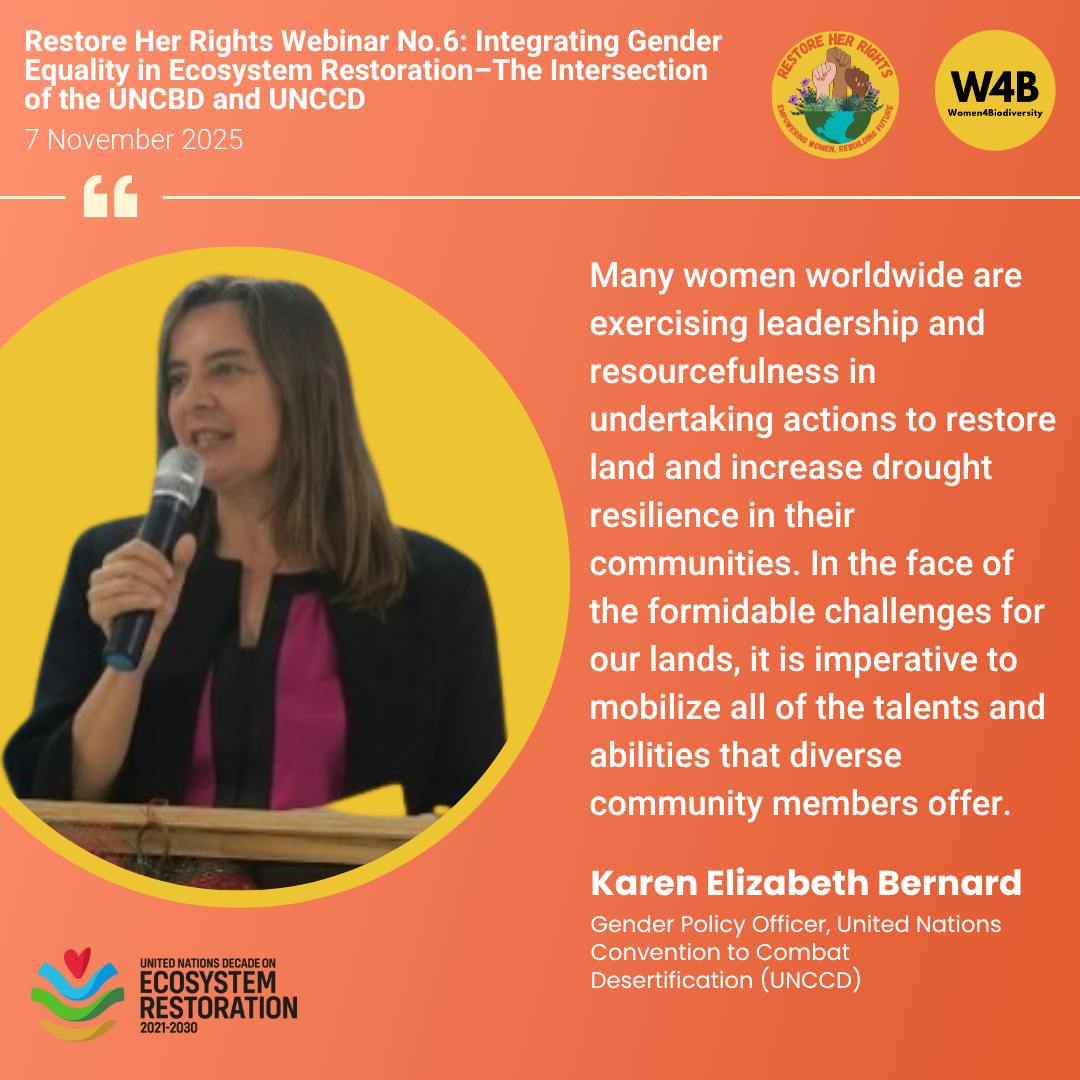
Karen Elizabeth Bernard, the Gender Policy Officer at UNCCD, discussed the challenges and progress in mainstreaming gender across the convention’s work, highlighting the need for sex-disaggregated data and the development of tools and guidelines for gender mainstreaming. She mentioned the success of providing earmarked travel funds and leadership training to support women’s participation in national delegations. The discussion also touched on the importance of diverse perspectives in achieving land degradation neutrality and the need for additional resources to implement the Gender Action Plan.
Karen presented research findings on women’s leadership in land restoration, highlighting 35 case studies from around the world. She emphasised how women’s involvement in land restoration not only addresses environmental challenges but also empowers women economically and socially. The research, led by Lorena Aguilar, demonstrated the importance of providing women with access to scientific training and technology to enhance their role in land management. Key findings included the need for non-traditional career opportunities for women, the strategic use of water and drought-resistant seeds, and the recognition of women as custodians of ancestral knowledge. The presentation concluded with the observation that gender-transformative examples often involve women taking on non-traditional roles and acting as multipliers of knowledge.
Empowering Women in Land Restoration
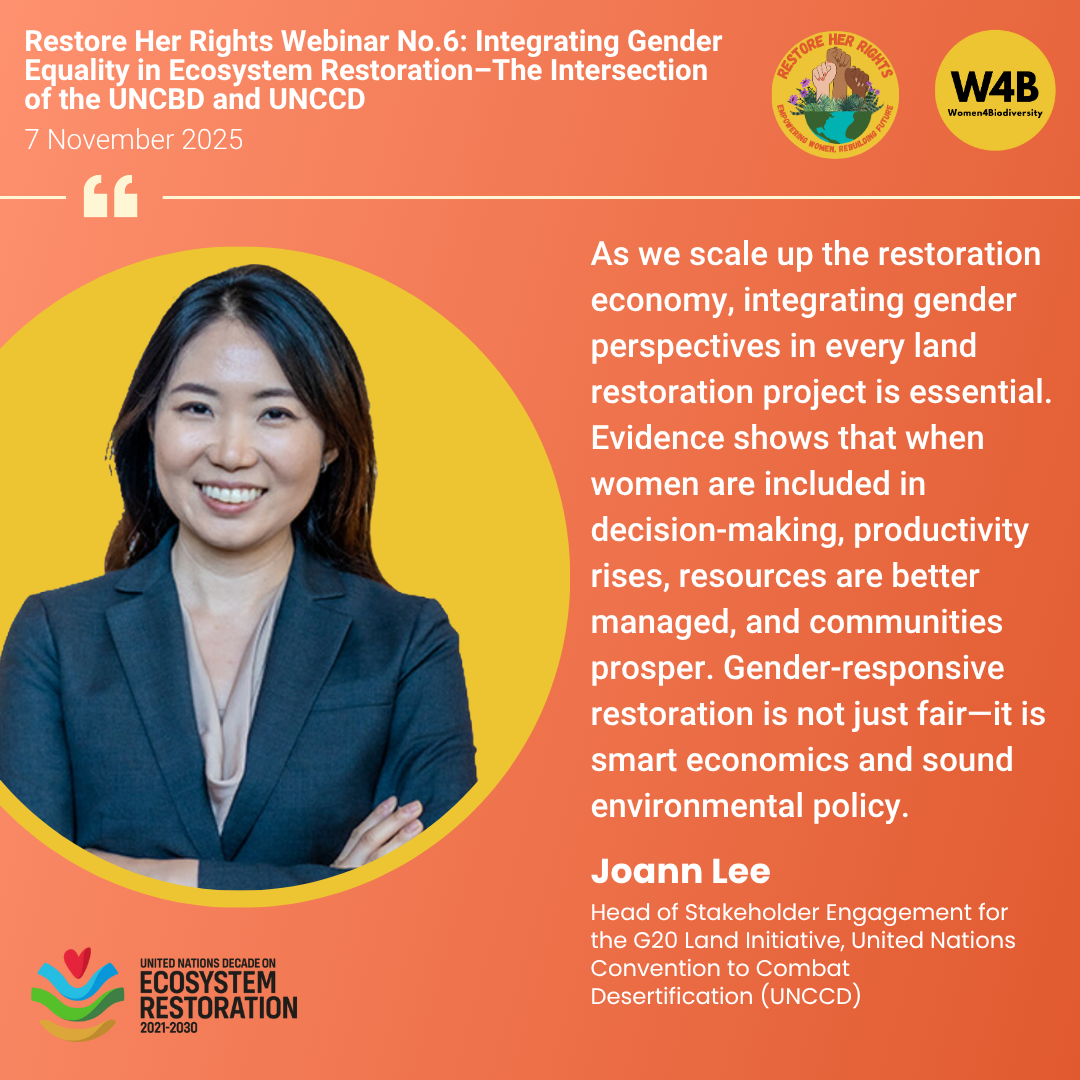
Joann Lee, Head of Stakeholder Engagement for the G20 Global Land Initiative, discussed the Initiative’s work to reduce degraded land by 50% by 2040, highlighting successful projects that empowered women in restoration roles. She shared examples from Senegal, Costa Rica, and Rwanda where gender integration led to improved outcomes, including increased household incomes, better soil and water management, and enhanced community ownership. Joann spotlighted the importance of women’s economic empowerment in the restoration economy, noting that nature underpins global Gross Domestic Product (GDP) and restoration has the potential to generate significant economic value. She outlined strategies to scale up gender equality in restoration efforts, including creating policy certainty, mobilising private capital, professionalising the sector, and building accountability systems.
Gender Integration in Land Restoration
The panellists discussed strategies for integrating gender considerations into land restoration projects, particularly in contexts where local social norms and power hierarchies posed challenges. Karen shared her experience in Tonga, where she negotiated equal participation of men and women in post-disaster recovery work despite conservative social norms, highlighting the importance of context-specific approaches and stakeholder engagement. Joann emphasised the role of faith groups in restoration efforts and their potential to drive social and economic development, while also noting a high return on investment (169%) for restoration projects in the Brazilian market.
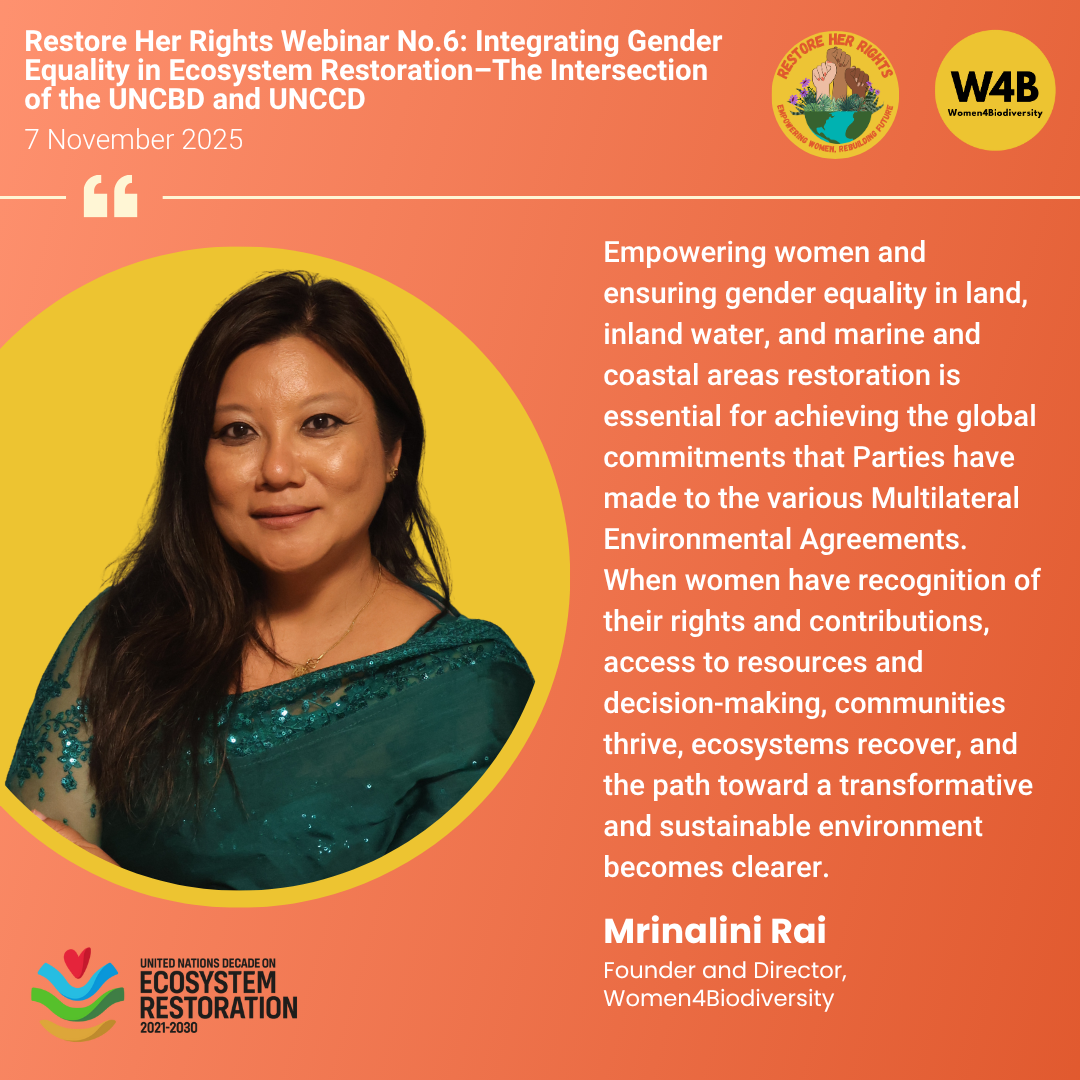
The webinar concluded with Mrinalini Rai, Founder and Director of Women4Biodiversity, providing a brief overview of the UNCBD’s gender policy and its implementation. She further spotlighted the linkages between mining, biodiversity loss, and the rights of IPs and LCs particularly women and children.
Participants at the webinar explored how women contribute to restoration and conservation efforts, often in a voluntary capacity. The conversations further highlighted the significance of policies in recognising and supporting women’s roles. The importance of integrating gender dimensions into restoration initiatives was highlighted, along with the need for funding, capacity building, and national policy changes to ensure women’s rights and empowerment. The conversation ended with a call for action to hold governments and economic actors accountable and to shift towards a moral code that prioritises environmental conservation and restoration.