
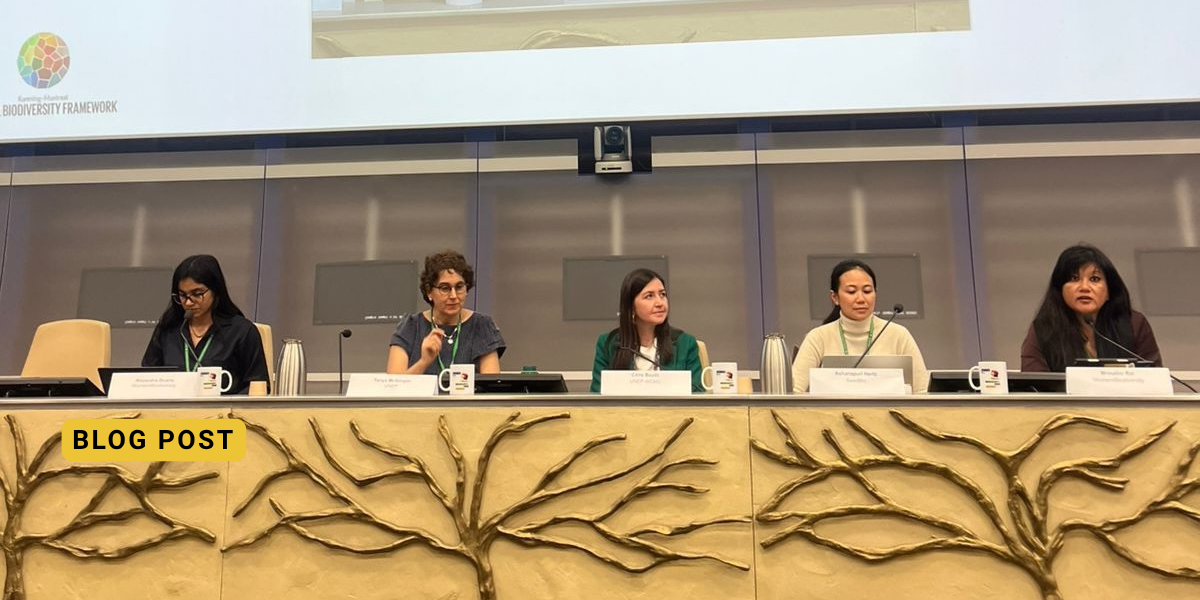
The speaker panel from L-R: Alejandra Duarte, Tanya McGregor, Céire Booth, Ashanapuri Hertz, and Mrinalini Rai. Image credit: Women4Biodiversity
On 16 February 2026, Women4Biodiversity, in collaboration with SwedBio, UN Environment Programme (UNEP), and UNEP- World Conservation Monitoring Centre (UNEP-WCMC), hosted a press conference on the margins of the sixth meeting of the Subsidiary Body on Implementation (SBI-6) of the Convention on Biological Diversity (CBD) in Rome. The event brought together experts to reflect on progress in implementing the Gender Plan of Action (GPA) (2023–2030) and identify the priorities needed to strengthen gender-responsive biodiversity governance. It provided a space to discuss how the GPA is being implemented across different levels, the constraints, and lessons learned from policy processes and implementation on the ground. The panel discussion brought together different perspectives from specialists working at the intersection of gender and biodiversity.
The press conference was moderated by Mrinalini Rai, Founder and Director of Women4Biodiversity. She emphasized the importance of ensuring that gender equality is incorporated into biodiversity governance processes rather than treated only as a complementary consideration, and that the experiences, knowledge, and leadership of women, particularly Indigenous women and women from local communities, are recognized and integrated into biodiversity policy.
Céire Booth from UNEP-WCMC presented the development of the component indicator designed to track the implementation of the GPA. She emphasized that while progress has been made in identifying methodological approaches, important gaps remain in the availability of gender-disaggregated data and in the systematic reporting of gender considerations in national biodiversity strategies and action plans.
Tanya McGregor from the GBF Early Action Support project at UNEP highlighted the importance of aligning the GPA with other global policy frameworks, including the Sustainable Development Goals. She stressed that gender considerations must be integrated into institutional planning processes rather than treated as an additional or optional component of biodiversity policies.
Alejandra Duarte from Women4Biodiversity shared insights from organizations working on implementing the Gender Plan of Action. Evidence was gathered through a survey conducted by W4B, with the objective of identifying the contributions made by relevant organizations to the Plan. Results indicate that many organizations are already contributing to gender-responsive biodiversity action, but their efforts remain uneven and often constrained by limited resources and institutional support.
Ashanapuri Hertz from SwedBio underscored the role of partnerships and sustained financing in advancing gender-responsive biodiversity action. She noted that initiatives that successfully integrate gender equality often demonstrate broader social and environmental benefits, including strengthened community resilience and improved climate adaptation outcomes.
The discussion highlighted significant gaps in monitoring, financing, and institutional capacity to effectively integrate gender-responsive implementation of the KM-GBF. Strengthening the availability of gender-disaggregated data, improving reporting mechanisms, and ensuring sustained support for the participation of women and civil society organizations will be critical for effective implementation. As countries continue advancing the implementation of the KM-GBF, the Gender Plan of Action provides an important entry point to promote more inclusive and equitable biodiversity governance.