
WHAT
Aligning with the global theme of International Women’s Day 2026, which is “Rights. Justice. Action. For ALL Women and Girls”, this webinar will examine the outcomes of the Minamata Convention COP-6 through a gender lens, exploring how women in artisanal and small-scale gold mining (ASGM) communities are disproportionately affected by mercury exposure, and what global policy commitments mean for their health and livelihoods.
WHEN
Tuesday, 10 March 2026, from 1:00 PM – 2:00 PM CET. Please check your timezone here.
WHERE
Online event.
WHO
- Mrinalini Rai, Founder & Director, Women4Biodiversity – Moderator
- Lara Ognibene, Legal Officer and Gender Focal Point, Secretariat of the Minamata Convention on Mercury
- Anna Holthaus, Project Manager, MSP Institute
- Mona Avalos, Natural Resources Defense Council (NRDC) – Senior Knowledge Management Coordinator, PlanetGOLD Global Project
- Yuyun Ismawati Drwiega, Co-founder of the Nexus 3 Foundation; Co-Chair of the International Pollutants Elimination Network (IPEN)
WHY
- Hear directly from experts on what the Minamata Convention’s most recent decisions mean for women in artisanal and small-scale gold mining communities
- Explore why women bear a disproportionate burden of mercury exposure and what targeted policy action is needed to protect them
- Engage with leading organisations working at the intersection of gender, health, and environmental justice, including IPEN, Nexus 3 Foundation and PlanetGOLD


Espanol
QUÉ
En consonancia con el tema global del Día Internacional de la Mujer 2026, que es «Derechos. Justicia. Acción. Para TODAS las mujeres y niñas», este seminario web analizará los resultados de la 6.ª Conferencia de las Partes (COP-6) del Convenio de Minamata desde una perspectiva de género, explorando cómo las mujeres de las comunidades dedicadas a la minería artesanal y a pequeña escala del oro (ASGM) se ven afectadas de manera desproporcionada por la exposición al mercurio, y qué significan los compromisos políticos globales para su salud y sus medios de vida.
CUÁNDO
Martes, 10 de marzo de 2026, de 13:00 a 14:00 CET. Por favor, compruebe su zona horaria aquí.
DÓNDE
Evento en línea.
QUIÉN
- Mrinalini Rai, Fundadora y Directora, Women4Biodiversity – Moderadora
- Lara Ognibene, Responsable Legal/Programa, Convenio de Minamata sobre el Mercurio
- Anna Holthaus, Jefa de Proyecto, Género y Sustancias Químicas, MSP Institute
- Mona Avalos, Consejo para la Defensa de los Recursos Naturales (NRDC) – coordinadora sénior de gestión del conocimiento, Proyecto Global PlanetGOLD
- Yuyun Ismawati Drwiega, cofundadora de la Fundación Nexus 3; copresidenta de la Red Internacional para la Eliminación de Contaminantes (IPEN)
POR QUÉ
- Escuche directamente de los expertos qué significan las decisiones más recientes del Convenio de Minamata para las mujeres de las comunidades dedicadas a la minería artesanal y a pequeña escala del oro
- Descubra por qué las mujeres soportan una carga desproporcionada de exposición al mercurio y qué medidas políticas específicas se necesitan para protegerlas
- Interactúe con organizaciones líderes que trabajan en la intersección entre género, salud y justicia ambiental, incluyendo IPEN, la Fundación Nexus 3 y PlanetGOLDx
Francais
QUOI
S’inscrivant dans le thème mondial de la Journée internationale des femmes 2026, « Droits. Justice. Action. Pour TOUTES les femmes et les filles », ce webinaire examinera les résultats de la 6e Conférence des Parties à la Convention de Minamata sous l’angle du genre, en analysant comment les femmes issues des communautés pratiquant l’exploitation artisanale et à petite échelle de l’or (ASGM) sont touchées de manière disproportionnée par l’exposition au mercure, et ce que les engagements politiques mondiaux signifient pour leur santé et leurs moyens de subsistance.
QUAND
Mardi 10 mars 2026, de 13 h 00 à 14 h 00 CET. Veuillez vérifier votre fuseau horaire ici.
Où
Événement en ligne. S’inscrire à l’événement.
QUI
- Mrinalini Rai, Fondatrice et Directrice, Women4Biodiversity – Modératrice
- Lara Ognibene, Responsable juridique/programme, Convention de Minamata sur le mercure
- Anna Holthaus, Chef de projet, Genre et produits chimiques, MSP Institute
- Mona Avalos, Natural Resources Defense Council (NRDC) – coordinatrice principale de la gestion des connaissances, projet mondial PlanetGOLD
- Yuyun Ismawati Drwiega, cofondatrice de la fondation Nexus 3 ; coprésidente de l’International Pollutants Elimination Network (IPEN)
POURQUOI
- Entendre directement des experts expliquer ce que les dernières décisions de la Convention de Minamata signifient pour les femmes des communautés d’exploitation aurifère artisanale et à petite échelle
- Découvrir pourquoi les femmes supportent un fardeau disproportionné en matière d’exposition au mercure et quelles mesures politiques ciblées sont nécessaires pour les protéger
- Échanger avec des organisations de premier plan œuvrant à l’intersection du genre, de la santé et de la justice environnementale, notamment l’IPEN, la Fondation Nexus 3 et PlanetGOLD

Event Summary
The sixth meeting of the Conference of the Parties to the Minamata Convention on Mercury (COP-6), which took place in November 2025 in Geneva, invited Parties to continue their implementation of decision MC-5/15 on the gender action plan, including to address health concerns of women and children during the biennium 2026–2027 (Annex I and II to UNEP/MC/COP6/16). The meeting also launched the Women’s Caucus for Minamata on Mercury (WC-MC) and invited Parties to provide financial resources to support the participation of representatives of the women’s caucus in the meetings of the COP to advance the equality and empowerment of women in the implementation of the Convention.
The global theme for International Women’s Day 2026 is “Rights. Justice. Action. For ALL Women and Girls. This theme aligns with the 70th session of the Commission on the Status of Women (CSW70), which focuses on strengthening access to justice for all women and girls. It calls for dismantling discriminatory laws, strengthening legal protections, addressing structural barriers, and ensuring that justice systems work for women and girls in practice.

The event focused on the outcomes of the sixth Conference of the Parties to the Minamata Convention on Mercury (COP 6) and addressed gender dimensions in artisanal and small-scale gold mining. Lara from the Minamata Convention Secretariat provided an overview of key decisions. She highlighted three main decisions: Decision MC-6/8 on artisanal and small-scale gold mining, Decision 6/15 on national reporting and the importance of ensuring and strengthening engagement with Indigenous peoples, and Decision MC-6/16 on addressing health concerns of women and children, and shared the priority activities adopted for 2026-2027, and under the same decision highlighted support to the coordination of the Women’s Caucus. Yuyun, Nexus 3 Foundation shared insights from her extensive experience working on mercury’s impact on women and children in ASGM hotspots, emphasizing the high mercury concentrations found in hair samples and the challenges faced by women in these communities. She also pointed out the gap in addressing other health issues that are concerning, including for childbearing mothers and children. The discussion highlighted the need to bridge the gap between global commitments and local implementation, particularly in addressing mercury pollution’s impacts on vulnerable populations.

Mona from the PlanetGOLD Programme explained how their programme incorporates gender-responsive strategies across four pillars: access to formal markets, mercury-free technologies, finance, and sector formalization. She detailed how the programme collects gender-disaggregated data and produces communication products to share best practices and outcomes.
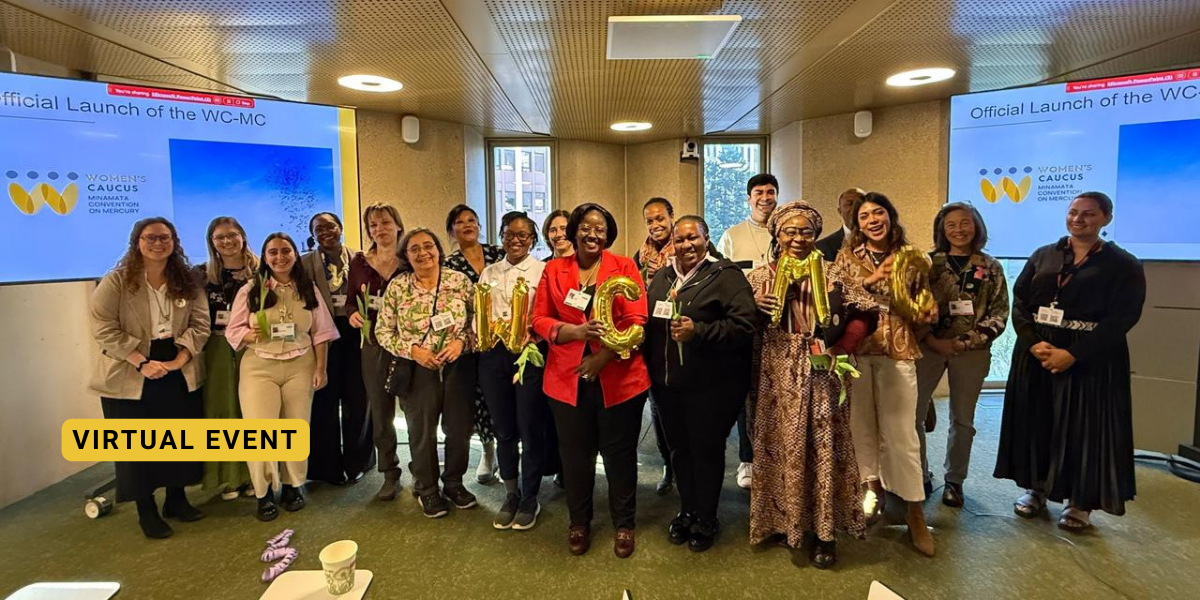
Anna then introduced the Women’s Caucus for the Minamata Convention on Mercury (WC-MC), which launched in May last year. WC-MC convened for the first time at COP6 and key highlights, included delivering four statements on ASGM, national reporting, the implementation for the Gender Action Plan, and mercury and the Kunming-Montreal Global Biodiversity Framework. The Women’s Caucus celebrated its official launch at COP 6 with a well-attended panel featuring representatives from Mexico and the Minamata Convention Secretariat, Marcos Oreliana the UN Special Rapporteur on Toxics and Human Rights, women’s representatives, Parties and others.

Richard Gutierrez from the Secretariat highlighted the importance of engaging in the review process at the national level of Article 7 implementation, particularly regarding gender-specific approaches. He further stated the importance of Article 7 which addresses Artisanal and Small-Scale Gold Mining (ASGM), requiring parties with more than insignificant ASGM to develop and implement a National Action Plan (NAP) to reduce, and if possible eliminate, mercury use.
The event focused on potential activities and events for this year, including encouraging participants to become members of the Women’s Caucus for Minamata on Mercury.